Decade-long ASU and Army Research Laboratory collaboration earns national recognition for seminal materials research
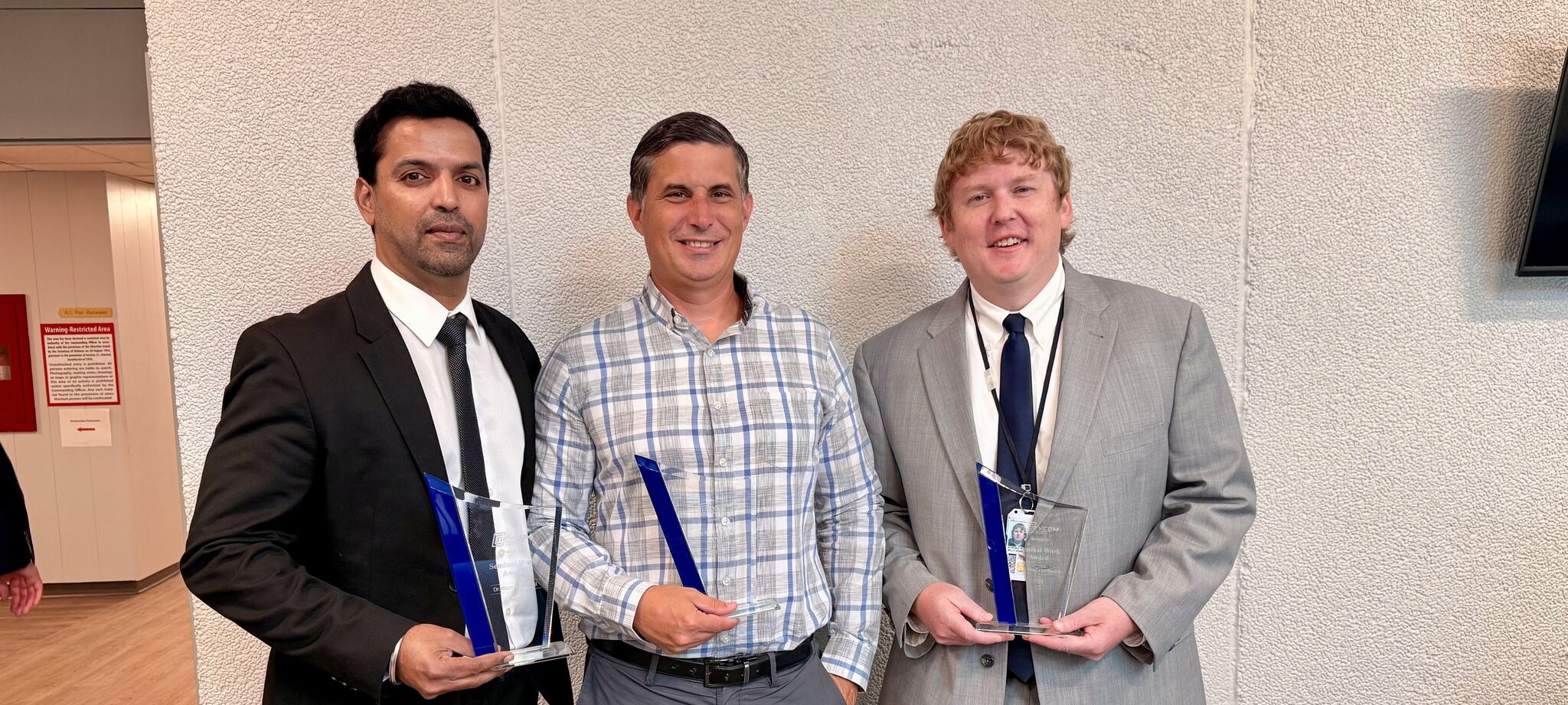
A decade-long collaboration between ASU and the Army Research Laboratory has advanced the development of copper-based materials to withstand extreme environments.
For more than a decade, Kiran Solanki and his collaborators have worked to overcome a fundamental limitation of copper: its excellent thermal and electrical conductivity comes with relatively low mechanical strength. That work, spanning more than 35 publications and the contributions of at least six doctoral students, has now earned national recognition for an ASU materials research team.
Kiran Solanki, a professor of mechanical engineering in the School for Engineering of Matter, Transport and Energy, and his research collaborators have received the Army Research Laboratory’s 31st Annual Honorary Award for Seminal Work.
The recognition stems from a long-standing research partnership between ASU and the Army Research Laboratory (ARL) focused on developing copper-based materials that retain copper’s valuable thermal and electrical properties while adding the strength and stability needed for extreme environments.
Engineering copper for extreme environments
Copper is valued for its ability to efficiently conduct heat and electricity, but its relatively low mechanical strength can limit its use in demanding environments. Solanki and his team set out to overcome that limitation by developing a copper-based material that preserves copper’s intrinsic advantages while enabling it to withstand higher mechanical and thermal demands.
To strengthen copper without giving up its desirable properties, Solanki’s team introduced a second material that does not naturally mix with copper. The resulting microstructure contains a dispersed strengthening phase within the copper matrix. More importantly, material can evolve at the microscopic level when subjected to extreme conditions, creating mechanisms that help it accommodate applied energy and resist failure.
“What makes this material interesting is that the microstructure is not just resisting applied energy; it can change in response to it. That gives us another way to accommodate extreme mechanical, thermal and other loading conditions while maintaining the properties that make copper useful,” Solanki says.
Manufacturing the material at a larger scale presented another challenge. Because the research relies on powder processing, Solanki and his collaborators had to identify the appropriate composition and processing conditions while maintaining consistency across batches. Producing the material in sufficient quantities was an important step toward evaluating its behavior and potential for structural applications.
A decade of collaboration
The research initially relied on computational modeling to explore material compositions and predict their behavior. As the project progressed, experimentation became equally important. Laboratory testing showed how the materials responded under different conditions, and the results were then used to refine our understanding of the underlying mechanisms.
“The experiments told us what the material was doing, but the computational work helped us understand why. We would go back and forth between the two, and that was important because it let us connect what we measured to the mechanisms responsible for the behavior,” Solanki says.
Individual doctoral students pursued different questions as the project evolved. Their work ranged from computational studies of the underlying physical mechanisms to advanced characterization of the microstructure and investigations of fatigue, radiation response, oxidation and high-rate behavior. Together, these efforts have built a broader understanding of how the material responds to demanding environments.
The recognition also reflects the cumulative nature of the research. As the project progressed, doctoral students took on different aspects of the work, building on the results and insights developed by the students who came before them.
“The most rewarding part has been seeing how the students have done the research in different directions. I can provide the questions, the direction and the guidance, but they are the ones who spend the time thinking through the problems and pushing the work forward. Each student built on what came before, and that is a big part of why the research has continued to grow,” Solanki says.
Solanki views the award as an opportunity to reflect on the dedication of his students, many of whom have since taken their experience into careers in academia and industry. The recognition, he says, provides a rare opportunity to look beyond the individual experiments and appreciate what the research team has accomplished over time.
“Research projects like this can go on for many years, and most of the time you are focused on the next experiment or the next question. This recognition gave me a chance to step back and really appreciate how much the students and collaborators have accomplished together over the past decade,” Solanki says.
The effort also drew expertise from beyond Solanki’s research group. At ASU, mechanical engineering professor Pedro Peralta contributed to examining the material’s behavior under high-rate conditions. Collaborators at George Mason University and the University of North Texas provided additional expertise and access to specialized capabilities and instrumentation as new research questions emerged.
From research to future applications
Solanki and his collaborators are now examining how the fundamental understanding developed through the research can translate into practical engineering applications.
Among the possibilities, Solanki is particularly interested in reusable rocket engine liners, plasma-facing components in fusion reactors and electric aviation motors. These applications share a common challenge: the need for materials that can withstand combinations of high temperatures, mechanical loads and other extreme conditions while continuing to perform reliably.
“The next step is to understand how we can deliberately engineer the mechanisms that give this material its behavior. The decade-long partnership with the Army Research Laboratory has given us a strong foundation for doing that taking what we have learned from the material and using it to think about new materials for environments where conventional materials reach their limits,” Solanki says.