Five ASU engineering students win first place in NASA ORBIT competition
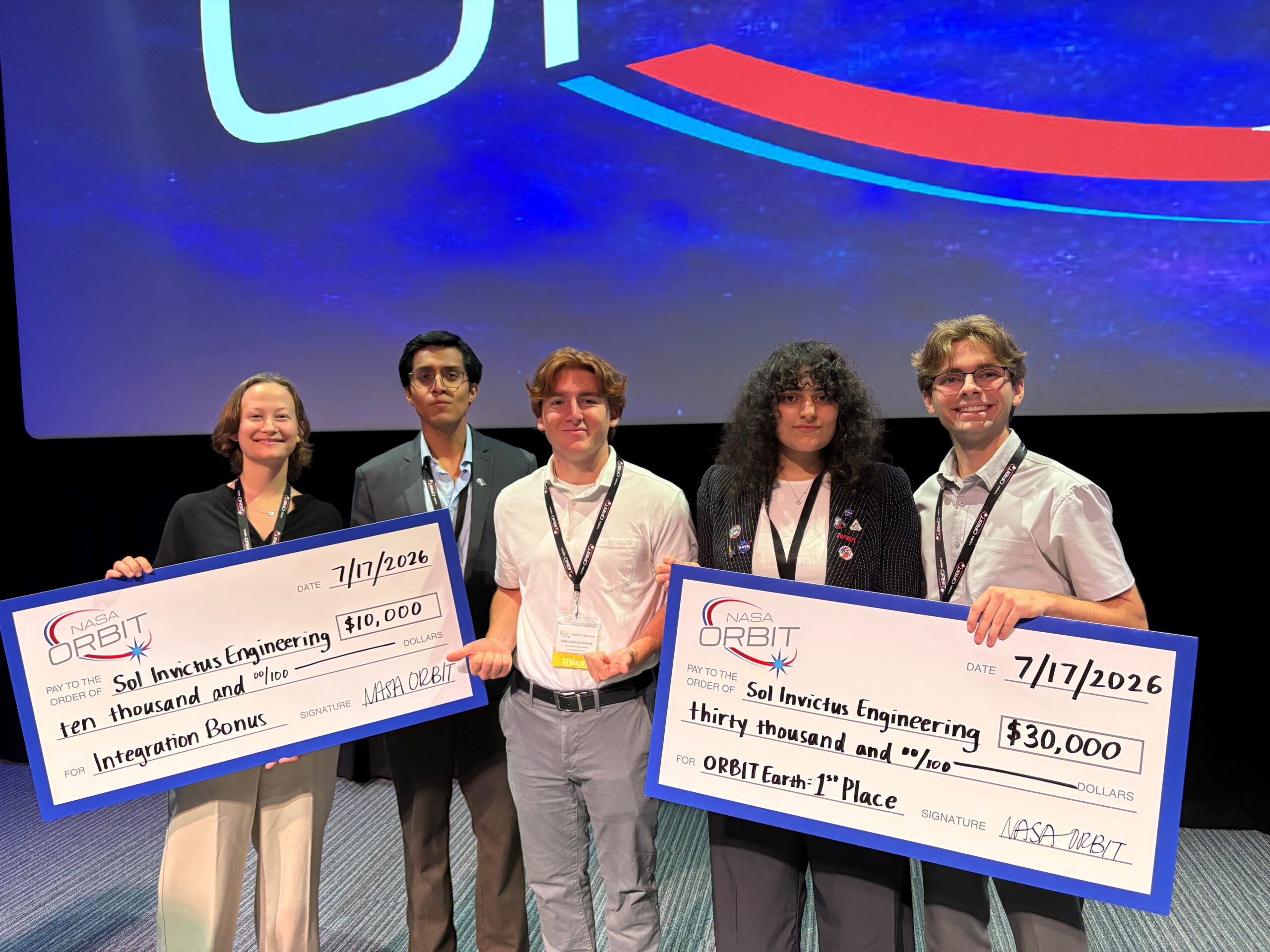
Team Sol Invictus from ASU places first in the NASA ORBIT Earth Competition by expanding upon a NASA patent to create a low-noise propeller.
Five engineering students from the School for Engineering of Matter, Transport and Energy at Arizona State University, set out to improve a NASA patent. Months later, they left Space Center Houston as the national champions of the NASA ORBIT Earth competition.
The victory was the result of nearly five months of collaboration, design, and testing. Now, through NASA’s ORBIT Accelerator Program, the team is turning the award-winning project into a startup.
The NASA ORBIT competition challenges university teams to develop viable products for the advancement of human exploration through the combination of engineering design and entrepreneurship. The competition is divided into two pathways: Earth and Space. The earth category invites students to build upon a pre-existing NASA patent to develop a practical solution with real-world market potential.
For team Sol Invictus – which translates to ‘Undefeated Sun’ in Latin – that meant reimagining a NASA patent for quieter, more energy-efficient rotor blades. By adjusting the structure and load placement of the blades, the team could maintain thrust while reducing both noise and power consumption, an advancement with a wide range of potential applications in drones, fans, and aerospace systems.
But before they designed a prototype, they had to build a team.
Building the team
Team lead Mikko-Dakota Roberts, a rising senior in aerospace engineering, discovered the NASA ORBIT competition at the beginning of the spring semester and immediately set out to recruit his classmates.
“I went out and collected the best people I could find,” Roberts says, “We started meeting weekly and looking over the challenge, trying to figure out what we wanted to build.”
In addition to Roberts, the five member team included aerospace engineering students Dylan Banhart, Pheona Gabrail and Lee Sorensen, along with mechanical engineering student Elvis Garcia Segundo.
While several teammates knew each other already through classes, others joined through personal connections. Garcia Segundo, after learning he was no longer able to pursue his plan of serving in the U.S. Air Force due to a medical disqualification, was invited to the team by Gabrail. The invitation gave him another path into aerospace.
“I knew exactly what I wanted to do, and that was to serve in the United States Air Force,” Garcia Segundo says. “Once I was disqualified, Pheona invited me to join the NASA ORBIT team instead. So, I was brought on board.”
Each member had a field of expertise: Banhart led computational fluid dynamics simulations and blade design, Gabrail managed systems engineering, requirements and risk analysis, Garcia Segundo focused on manufacturing and testing, Sorensen focused on presentations and technical deliverables and Roberts oversaw project management, integration and communications.
However, the project was highly collaborative. Rather than working in isolation, the team regularly reviewed each other’s work.
“We all had our own expertise that we used in specific aspects of the project,” Gabrail says. “But we all helped each other, cross-checked progress and made sure everything worked together. That’s what made our team so cohesive.”

Designing a quieter rotor blade
After assembling the team, the next challenge was selecting a NASA patent that could be turned into a commercially viable product. After exploring several possibilities, team Sol Invictus decided to use a patent focused on reducing the noise generated by rotating blades.
“The idea was to make a quieter propeller while keeping the same efficiency, generating the same force and using less power,” Banhart says. “That was the premise behind both the patent and our project.”
Their design modified the geometry of the propeller blade by changing how it twists from the center to the end of each blade. By redistributing aerodynamic forces, they are able to reduce noise without sacrificing performance.
Beyond reducing noise, the NASA patent estimated the redesigned blades could reduce power consumption by nearly 15 percent without inhibiting performance.
Although the team initially considered choosing a project about lunar bases, the students ultimately chose a project better aligned with their experience in aerodynamics.
According to Sorensen, “We were very unique with what we chose for our project, and it matched our expertise better than the lunar base idea.”
Choosing a project that matched their expertise allowed the team to move confidently into the designing phase.
“We were all learning together,” Banhart says. “None of us felt like we had all of the knowledge going into it, and it left us open to trying different iterations of the design.”
However, transforming the idea into a working prototype proved to be more challenging than the team anticipated.
Rather than providing specifics on the design, the patent focused on the underlying concepts, leaving Sol Invictus to determine many design parameters themselves.
“The patent was extremely vague,” Garcia Segundo says. “When it came to designing our airfoil and actual propellers, we had a hard time figuring out the specifics of what we needed to build.”
After weeks of researching aerodynamic theory, evaluating blade geometries and refining their design, the team settled on a direction. Using NASA’s OpenVSP software, the team developed models of the conventional propeller and their improved design, before running computational fluid dynamics simulations in ANSYS Fluent to get data on the performance of each blade under operational conditions.
While the simulations provided a good proof of concept, Sol Invictus knew computer models alone wouldn’t be sufficient. To validate the project, the team manufactured physical prototypes with the help of the ASU Machine Shop, and shop manager Leonard Bucholz.
Once manufactured, the team was able to move into physical testing.
From simulation to experimentation
Under the guidance of Dr. Steele, Sol Invictus utilized ASU’s wind tunnel to measure thrust, efficiency and acoustic performance while rotating the propellers at various speeds.
Additionally, Sol Invictus partnered with the ASU student organization Air Devils, working closely with Air Devils propulsion lead Anthony to gather additional performance data through the use of Air Devil’s motor test stand.
Throughout the design process, Sol Invictus relied heavily on faculty mentors at ASU. Dr. Valana Wells, an expert in rotary dynamics and acoustics, helped the students move forward in the project.
“We had a lot of unknown parameters in the beginning,” Roberts says. “Dr. Valana Wells provided us with baseline numbers that are standard in the industry, which gave us something to compare our data to.”
Despite spending nearly five months developing the project, much of the team’s experimental work happened in the weeks between qualifying for finals and presenting in Houston. After advancing to the final round, the team had little time to complete the manufacturing, acoustic analysis, wind tunnel testing and CFD validation. According to the team, it was all made possible through the support of faculty, students and staff across ASU.
“A lot of people came together very quickly to help us get there,” Banhart says.
Making it to NASA ORBIT
After making it to the final round, team Sol Invictus traveled to NASA’s Space Center in Houston to compete against the other student finalists. Their final challenge was blending engineering and business to convince judges that their technology and integration strategy had real-world commercial potential.
When the team learned it had advanced to the finals, Gabrail and Garcia Segundo were eating lunch together when they got the news.
“We just jumped up and started yelling,” Gabrail says. “It was amazing.”
As finalists in the ORBIT Earth competition, the students delivered a 15-minute presentation followed by a two-hour poster session where NASA judges, industry professionals and visitors stopped to ask questions about their project.

“Everyone had fantastic projects,” Banhart said. “We got to connect with a lot of people who can help us in developing our careers.”
When the winners were finally announced, team Sol Invictus heard its name called for first place.
Beyond the win, the experience validated months of work and proved to the team that their countless hours of research and testing had paid off. Additionally, the team earned a share of $55,000 in prize funding, along with valuable connections with NASA engineers and industry leaders.
“Seeing all our hard work pay off really validated the idea that putting in the time to work on something you’re passionate about will give you results,” Banhart said.
For the team, winning the NASA ORBIT competition wasn’t just about winning. The experience strengthened each member’s confidence as an engineer, introduced them to mentors across ASU and NASA and left them with a path forward in their careers.
Throughout the project, Sol Invictus received guidance from faculty advisors Dr. Matthew Peet and Dr. Raghavendra Murthy, along with support from numerous other ASU staff and industry professionals, including Dr. Jeonglae Kim, Dr. Marcus Herrmann, Dr. Huei-Ping Huang, Aliya Takano and Andy Gee. This network of mentors helped transform the ambitious idea into an award-winning project.
“I feel a real sense of community here at ASU because of how much support we got from professors, lab management, the machine shop and everyone who helped us along the way,” Roberts says.
This experience helped reshape the team’s goals for their future. For Garcia Segundo, the competition reinforced his passion for aerospace engineering. For Banhart, it confirmed his interest in aerodynamic research and testing. Roberts will continue building experience through internship opportunities at Raytheon and NASA, while Sorensen and Gabrail plan to continue their graduate studies.

However, winning the competition wasn’t the end of the project.
Beyond first place
Following the competition, team Sol Invictus has entered NASA’s ORBIT Accelerator Program, where the students are further exploring how to turn their low-noise rotor technology into a commercial project. Alongside advisors from JPMorgan, the team plans to turn their idea into a startup business, extending the impact of their project far beyond the competition.
Looking back, the team credits its success to not just technical expertise, but to their ability to work together with open minds and humility.
“When it came to communication throughout the project, it was never me versus you,” Gabrail says, “It was me and you versus the problem. I’m glad we got the opportunity to work with each other that way.”